


A spare part is critical when its failure stops ice output or risks stored product, the machine cannot run safely without it, or replenishment takes longer than the plant can tolerate. Rank candidates against those tests and your site's duties before committing freight budget and shelf space.

What Makes an Ice-Plant Spare Part Critical at a Remote Site?
A part is critical when its failure stops production, risks product or blocks a legal duty — and replenishment takes longer than the plant can tolerate. Maintenance duty points the same way: the Provision and Use of Work Equipment Regulations require equipment to be kept in efficient order and good repair, with a maintenance log where one exists, and maintenance by a competent person using the manufacturer's instructions. The HSE guidance on maintenance of work equipment sets out those duties for Great Britain.
| Decision test | Question to ask about the part | Stocking implication |
|---|---|---|
| Production consequence | Does this failure stop the whole line, or only one circuit? | Single points of failure that stop the plant belong on the list; duplicated circuits can wait. |
| Product consequence | Could a stop spoil ice, fish or food held in process? | Parts that protect temperature control rank above convenience items. |
| Replenishment distance | How many days by air, customs clearance and inland transport? | Hold stock wherever replenishment outlasts the shutdown the plant can absorb. |
| Identification confidence | Can you name the exact part from the nameplate and the current manual? | Resolve identification before you spend; unidentified parts should not be stocked. |
| Regulatory exposure | Does it sit in a pressure system, refrigerant circuit or monitored food-safety control? | Legal duties may decide who may fit it and which records must exist. |
Criticality is site-specific, not universal. A seal that stops a single-line island plant may be routine at a site with two independent machines and a local supplier. Re-test the ranking whenever the production layout, the product mix or the transport route changes, and record the reasoning in the maintenance log so the next engineer inherits a decision rather than a habit.
Which Spare-Part Groups Should a Remote Ice Plant Screen?
Screen by function rather than part number so nothing that can stop the plant is missed: water and ice-making, refrigeration, drives and motors, controls and instrumentation, handling and structure, and consumables. The part must let a competent person restore the equipment to efficient order using the manufacturer's instructions. 深圳市兄弟制冰系统有限公司 states on its own website that it was established in October 2007 and publishes a range covering flake, tube, block, plate, cube and slurry ice machines, water chillers, freezers, automatic ice storage and delivery systems and an ammonia refrigeration system category, so a multi-machine site has to screen water, refrigerant and handling functions together rather than one machine type.
| Spare group | Typical items | Why remote sites rank it high | Verify before stocking |
|---|---|---|---|
| Water and ice-making | Water pumps, nozzles, filters, ice-making surfaces | Flow or ice-release failure stops output within hours | Ice- and food-contact material and finish, plus exact part reference |
| Refrigeration circuit | Filter driers, valves, pressure switches, seals, gaskets | Refrigerant loss stops ice and can spoil stored product | Refrigerant compatibility; whether the part sits in a pressure system |
| Drives and motors | Fan motors, gearbox components, belts, bearings | One failed drive stops a compressor or harvester cycle | Frame, mounting, shaft and electrical data matched to the nameplate |
| Controls and instrumentation | Controllers, relays, fuses, temperature probes, sensors | The plant runs blind or trips, and monitoring records stop | Control generation, input type and calibration requirements |
| Handling and structure | Door seals, hinges, chains, ice-delivery components | Hygiene and throughput degrade before total failure | Dimensions taken from drawings, not photographs |
| Consumables and fixings | Lubricants, O-rings, fasteners, adhesives | Small items cause long stops when nothing local matches | The manufacturer's specified type and grade |
- List every component whose single failure stops the whole plant, and set aside parts that a working duplicate already covers.
- Convert your normal replenishment route into days; anything longer than your tolerable shutdown belongs on the stock list.
- Pull each candidate's exact reference from the manual and the machine nameplate instead of from memory or an old invoice.
- Flag every item inside a pressure system, a refrigerant circuit or a monitored food-safety control, because those carry a competence decision as well as a stock decision.
- Ask the supplier for the drawing or specification sheet that matches the revision of your machine, and record the screening decision in the maintenance log.
How Do You Confirm a Spare Fits Before You Stock It?
Confirm fit from documentable data, not a photograph: nameplate identity and revision, the current manual or revision-controlled drawing, fluid and electrical compatibility, ice- and food-contact materials, and delivered documentation. Because maintenance must be by a competent person using the manufacturer's instructions, an unverifiable part is a stop, not a calculated risk. Where the part affects a temperature control, note that the FDA's Fish and Fishery Products Hazards and Controls Guidance is written to help seafood processors build HACCP plans, and its related training material covers continuous temperature monitoring plus accuracy checks and calibration of temperature-recording equipment.
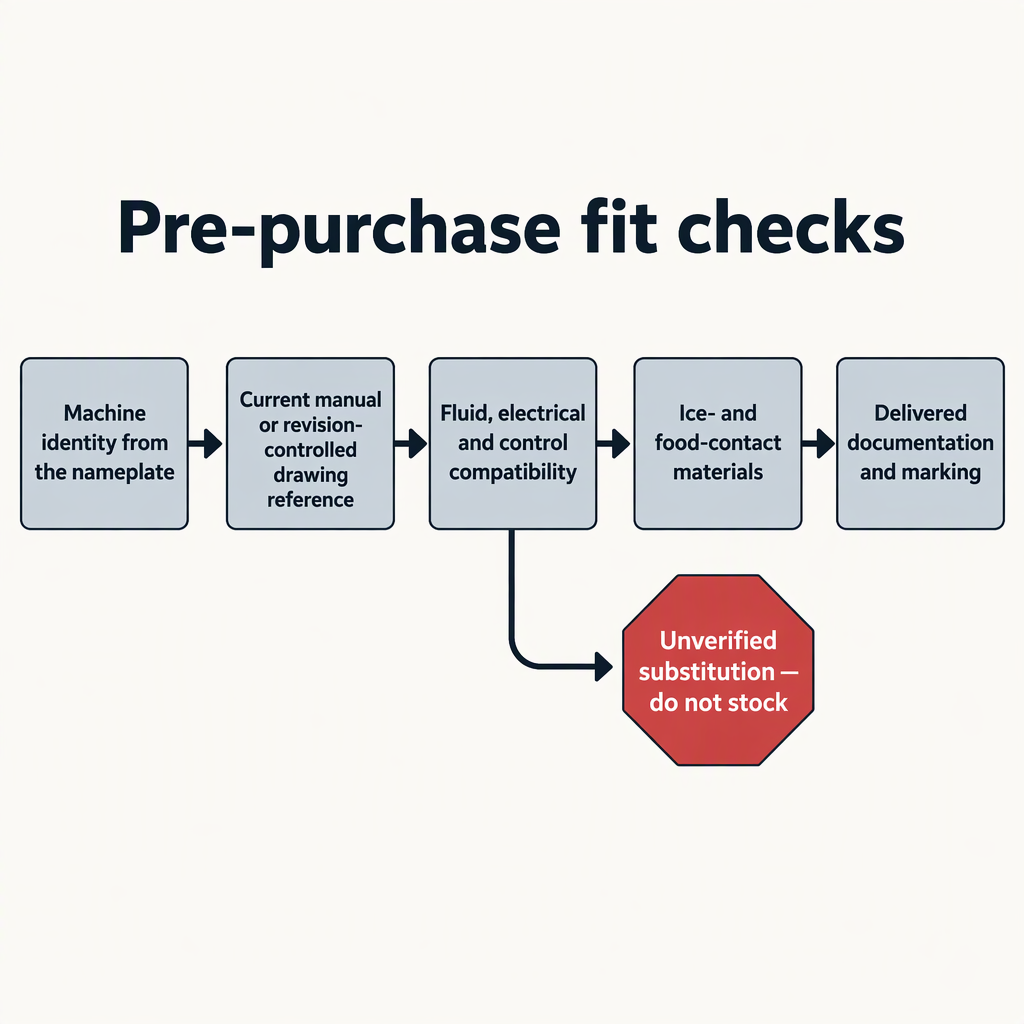
- Capture the machine identity from the nameplate: model, serial number, build or revision year, refrigerant, and control generation.
- Take the part reference from the current manual or a revision-controlled drawing, and ask the supplier for the revision that matches your serial number before you order.
- Check fluid and electrical compatibility together: refrigerant, brine or lubricant on one side; voltage, frequency, phase, mounting dimensions and control generation on the other, including whether the part sits inside a pressure system.
- Check ice-contact and food-contact materials and finishes, so cleaning routines and hygiene controls still work with the replacement fitted.
- Require delivered documentation and marking: part reference, revision, and fitting instructions a competent person can follow.
Before any manual access to an installed machine, switch off and disconnect its power supply — including any separate control supply — lock the isolation off, and follow only the access the manufacturer's manual permits. Isolation of plant and pipelines containing pressurised fluid, gas or hazardous material before maintenance is part of the same duty. Refrigerant and pressure work belongs to a competent, certified technician; never crack a joint to check a part.
How Should Spares Be Stored and Preserved on Site?
Store spares so they are still fit when they are needed: clean, dry, sealed, identified and recorded, with the store treated as part of the maintenance system rather than a back room. The duty to keep equipment in efficient order and in good repair reaches whatever you put back on the machine, so a part that has sat unprotected for years needs inspection before it is fitted.
- Seal and label every item with part reference, revision, the machine serial it belongs to, and the date it entered the store.
- Keep elastomer seals, gaskets and belts away from direct sun, ozone sources, motor heat and oil mist.
- Store control boards, sensors and probes in antistatic protection with desiccant, and keep them off concrete floors.
- Keep lubricants and chemicals closed and segregated from ice-contact parts, and retain the supplier's label.
- Inspect stock on a fixed cycle and record the inspection; withdraw anything with damaged packaging, corrosion, hardening or lost identification instead of fitting it.
Storage life is a property of the part and its packaging, not a universal interval. Ask the supplier for the storage instructions and any stated limits for the exact item, and record the date it entered the store, so the decision to use or scrap it rests on the item's own history. Parts held for a pressure system or a food-safety control should be re-confirmed as suitable before they go back into service.
Which Legal Duties Change the Spare-Parts Decision?
Yes, when the plant holds a regulated substance such as ammonia or the site is a covered food facility, because those duties decide two things: who is allowed to fit the part and which records must exist. In the United States, the Risk Management Program requires facilities using extremely hazardous substances to develop a Risk Management Plan, revise and resubmit it every five years, and applies a General Duty Clause; the programme also publishes ammonia-refrigeration resources. The rule defines who is covered, so confirm the current threshold and your facility's status with the programme.
Three duty families decide who may work on a spare and what must be recorded:
- In Great Britain, the Pressure Systems Safety Regulations 2000 require a written scheme of examination to be in place and an examination to be completed before qualifying pressure equipment is used. A relevant fluid includes compressed or liquefied gas above 0.5 bar above atmospheric pressure, and the supplier of an installed system may take written responsibility for the scheme, its operation, maintenance and record keeping.
- In the United States, the EPA states that Section 608 of the Clean Air Act prohibits intentionally venting ozone-depleting substances and their substitutes, such as hydrofluorocarbons, while maintaining, servicing, repairing or disposing of refrigeration or air-conditioning equipment, and that a technician certification programme applies.
- For covered US food facilities, the FDA requires a written food safety plan including a hazard analysis and risk-based preventive controls; refrigeration can be such a control, with parameters and critical limits, and monitoring and corrective actions must be documented.
Jurisdiction decides which of these duties applies to your site. A rule that governs a plant in one country does not transfer to another, so ask the local environmental and safety authority which refrigerant-handling, pressure-equipment and food-record requirements you must meet. The same duties decide competence: certified personnel for refrigerant work, a competent person for pressure equipment, and a documented check for anything that affects a food-safety control.
What Should the Spare-Parts RFQ and Purchase Order Contain?
Write the order so the delivered part cannot be mistaken: identify the machine by model, serial and revision; quote the exact part reference and revision; state the documentation required; and ask the supplier to confirm fit in writing before dispatch. Record the order, arrival date and fitted machine in the maintenance log.
- Machine identity: model, serial number, build or revision year, refrigerant and control generation.
- Part identity: exact reference, revision and quantity, with the manual revision or drawing number the reference came from named in the order.
- Written fit confirmation: the supplier's statement that the part suits your nameplate data, or a statement of exactly what differs.
- Materials and compatibility: specified materials for ice- and food-contact surfaces, and compatibility with the refrigerant, brine and lubricant in use.
- Documentation on delivery: packing list showing reference and revision, fitting instructions, and material or pressure-test certificates where the application requires them.
- Marking and receipt: batch or serial marking on the part itself so it can be matched to the order, an arrival inspection for damage, and a recorded receipt in the maintenance log.
Conclusion
Build the remote stock list from consequences and distance, verify every line before you pay to ship it, store what you hold so it is still fit, and record the whole cycle in the maintenance log. Decide, verify, store, document — that sequence is what stops one failed seal from becoming a lost season.
- Rank parts by whether their failure stops production, risks product or blocks a legal duty, and by how long replenishment really takes.
- Screen by function — water and ice-making, refrigeration, drives, controls, handling and consumables — before hunting part numbers.
- Verify fit from nameplate data, the current manual revision, fluid and electrical compatibility, contact materials and delivered documentation.
- Store spares labelled, sealed, protected and inspected, and record when each item entered the store.
- Treat regulated systems separately: refrigerant handling, pressure equipment and food-safety controls each bring their own competence and record duties.
Frequently Asked Questions
Six points come up repeatedly when remote ice plants specify spares: whether refrigerant may be released, whether a pressure part needs an examination before use, what food-safety records must exist, how many units to hold, what must arrive with the part, and whether a generic substitute is acceptable.
Can we vent refrigerant while replacing a component?
Not in the United States. The EPA states that Section 608 of the Clean Air Act prohibits intentionally venting ozone-depleting substances and their substitutes, including hydrofluorocarbons, during maintenance, servicing, repair or disposal of refrigeration equipment, and that a technician certification programme applies. Elsewhere, ask your environmental authority which recovery and certification rules apply, and use a certified technician.
Do pressure-retaining parts need a written scheme of examination before use?
In Great Britain, the Pressure Systems Safety Regulations 2000 require a written scheme of examination and an examination before qualifying pressure equipment is used; a relevant fluid includes compressed or liquefied gas above 0.5 bar above atmospheric pressure. Confirm in writing who holds the scheme, operation, maintenance and record duties before a replacement part returns to service.
How do food-safety rules affect which spares and records a food plant keeps?
In the United States, covered food facilities must have and implement a written food safety plan with a hazard analysis and risk-based preventive controls; refrigeration can be one of those controls, with parameters and critical limits, and monitoring and corrective actions must be documented. Seafood processors working to HACCP guidance also treat temperature monitoring, and the accuracy checks and calibration of temperature-recording equipment, as part of the control system. That puts probes, sensors, chart recorders and their calibration on the spare and service list, together with the records that show they worked.
How many of each spare should we hold?
There is no universal number. Set quantity from replenishment time, tolerable failure time, and whether a duplicate machine carries the load. Record the reasoning in the maintenance log so the quantity can be reviewed.
What documents should arrive with a delivered spare part?
At minimum a packing list stating the part reference and revision ordered, fitting instructions a competent person can follow, and any material, pressure-test or conformity document the application requires. Marking should match the order; record receipt in the maintenance log and file the documents with the machine record.
Can a locally bought generic part replace an OEM part?
Only after checking it against the manufacturer's instructions and machine data, and where no rule requires specific approval. A part that matches dimensions but not material, pressure rating, electrical data or control generation may fail early or undermine a food-safety control. If instructions specify a part, follow them; record any approved deviation.
