

Treat ice machine rated capacity as a standardized comparison point, not as a guarantee of the ice your seafood plant, food factory, or ice operation will receive at its own installation. When efficiency labels or criteria are part of the shortlist, compare energy and potable-water metrics by equipment type and harvest-rate range before using the rating in a purchase decision.
Rated capacity is a standard-condition comparison point
Rated capacity is useful for comparing machines on a common basis because AHRI states that automatic commercial ice-maker ratings in its ACIM program are verified by test at Standard Rating Conditions.
For procurement, that means the rated number should be read as a controlled comparison value. It is not, by itself, a site production promise for a hot processing room, a remote condenser arrangement, a particular water supply, or a factory operating schedule.
The AHRI Automatic Commercial Ice-Makers and Ice-Storage Bins program describes a scope for factory-made automatic commercial ice-makers producing 50.0 to 4,000.0 lb of ice per day at Standard Rating Conditions and states that ratings are verified by test at those conditions.
Use the rated value to establish whether a model belongs in the discussion, then require the supplier to show how the expected daily output was translated for the proposed installation.
Which rated metrics matter before a quote?
Before accepting a quote, compare the rated harvest rate together with the rated consumption metrics that apply to the machine type, rather than comparing only a headline daily capacity.
Seafood and food facilities often buy ice for chilling load, production continuity, and storage planning. A quote that lists only a capacity number can leave important utility and ice-form questions unanswered.
| Rated item to request | Why it matters in selection |
|---|---|
| Ice harvest rate | It is the central rated output metric used for comparing automatic commercial ice-makers under the rating program scope. |
| Potable water use rate for batch machines | For batch-type machines, water use belongs in the rated comparison, not only in a separate operating-cost discussion. |
| Condenser water use rate | Where condenser water use applies, it affects the utility basis of the quote and should be separated from ice output. |
| Energy consumption rate | Energy consumption rate is one of the certified rating categories buyers can compare across eligible equipment. |
| Ice hardness factor for continuous machines | For continuous machines, AHRI lists ice hardness factor as a rating category, so buyers should not treat all output weight as identical without reviewing the applicable metric. |
When a supplier references AHRI certification, ask for the exact rated values covered by the AHRI ACIM program, not only a catalog capacity statement.
Do not confuse efficiency criteria with site output
Efficiency criteria help compare energy and potable-water performance within defined equipment categories, but they do not prove the daily output your site will obtain after installation.
| Buyer question | What the criterion can support | What still needs site review |
|---|---|---|
| Is the machine compared within the right harvest-rate range? | ENERGY STAR lists criteria by ice harvest-rate range. | Confirm that the proposed machine size matches the plant's daily and peak ice demand. |
| Is the equipment type the same? | ENERGY STAR separates criteria for air-cooled batch-type and continuous-type commercial ice makers. | Confirm whether the ice type, handling method, and storage arrangement fit the production process. |
| Are energy and potable-water figures included? | The criteria page lists energy consumption-rate and potable-water-use requirements. | Ask how utilities, operating hours, and installation assumptions are represented in the supplier's site-output estimate. |
What to verify for the actual installation
For the actual installation, require a bridge between the standard-condition rating and the supplier's proposed site output, with assumptions stated in writing before approval.
- Ask whether the quoted capacity is an AHRI-style standard-condition rating, another published rating, or a supplier projection for your site.
- Request the rated ice harvest rate and each applicable rated consumption metric in the same document, so capacity is not separated from water and energy use.
- Provide the supplier with the planned location, operating schedule, ice storage approach, and production demand profile, then ask which assumptions were used to estimate site output.
- Ask whether the quoted output is for continuous operation, shift-based operation, or a defined daily production window.
- Request the conditions under which the supplier will accept or reject a site-output performance check after installation.
- Keep rated capacity, expected site output, storage capacity, and utility consumption as separate approval lines in the purchase file.
Shortlisting versus final selection: a buyer decision table
A rated-capacity number is usually enough for early shortlisting, but final selection should wait until rated metrics, efficiency criteria, and site-output assumptions are all aligned.
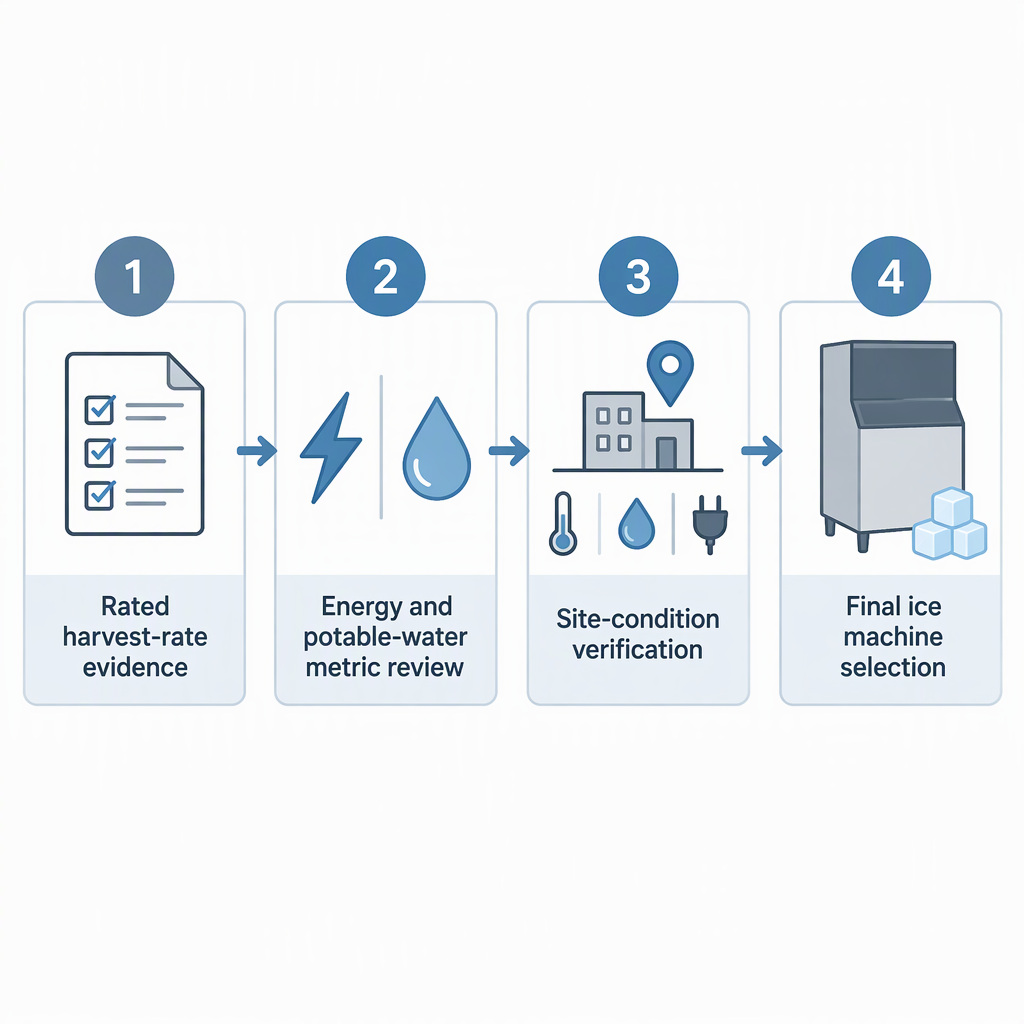
| Decision stage | Use rated capacity for | Do not use it for | Buyer action |
|---|---|---|---|
| Initial shortlist | Comparing machines within the rating program's automatic commercial ice-maker scope. | Promising installed daily production. | Remove obviously undersized or mismatched options. |
| Utility and operating comparison | Reviewing rated energy, water, and applicable machine-type metrics. | Assuming equal operating cost from equal capacity alone. | Compare harvest rate together with water and energy metrics. |
| Efficiency-screened shortlist | Checking whether efficiency criteria are organized by equipment type and harvest-rate range. | Using an efficiency criterion as proof of site output. | Confirm the category and request the supplier's site-output calculation. |
| Final approval | Supporting a structured comparison file. | Replacing the project-specific sizing review. | Approve only when rated values and installation assumptions are both documented. |
Procurement questions to send before approval
Send suppliers a short written question set that separates rated capacity, efficiency metrics, and expected site output before commercial approval.
- What is the rated ice harvest rate, and what rating basis or certification program is being referenced?
- Which rated water-use, condenser-water, energy-consumption, or ice-hardness metrics apply to this machine type?
- If ENERGY STAR criteria are referenced, which equipment type and harvest-rate range are being used for comparison?
- What daily site output is being proposed for our installation, and which assumptions change that estimate?
- What information do you need from our plant before confirming the final selection?
- How should storage, peak demand, and production schedule be documented so that machine output and usable ice availability are not confused?
- Which documents will be attached to the purchase approval: rating data, efficiency data, site-output calculation, and operating assumptions?
Conclusion
Buyers should use rated capacity to compare options, then require written site-output assumptions before final selection.
The safest procurement position is to treat a rating as a controlled comparison value. Efficiency and potable-water criteria add useful screening information, but they should sit beside—not replace—the site-output calculation. For seafood plants, food factories, ice plant operators, and engineering procurement teams, the approval file should show rated harvest rate, applicable consumption metrics, machine type, efficiency category, and the assumptions behind the expected installed output.
FAQs about ice machine rated capacity versus actual output
These answers help buyers keep standard ratings, efficiency comparisons, and installation expectations separate during selection.
Is rated ice machine capacity the same as actual site output?
No. Rated capacity is a comparison value tied to a stated rating basis such as Standard Rating Conditions, while actual site output should be confirmed through project-specific assumptions.
Do batch-type and continuous-type ice machines use the same verification metrics?
Not always. AHRI lists potable water use rate for batch machines and ice hardness factor for continuous machines among the program's rating categories, so buyers should check which metrics apply to the machine type.
Does ENERGY STAR certification prove the actual daily output at a buyer's installation?
No. ENERGY STAR commercial ice maker criteria address energy consumption rate and potable water use by equipment type and harvest-rate range; they do not by themselves establish the installed daily output for a specific site.
Can buyers compare machines by tons or pounds per day only?
A daily capacity figure is a useful first screen, but buyers should also compare the rated harvest rate with applicable water, condenser-water, energy, and machine-type metrics before approving a quote.
Should procurement request exact standard test conditions?
Yes. If a supplier cites a standard-condition rating, request the document or certificate that states the rating basis and the values being claimed for the proposed model.
What if a supplier provides a site-output estimate that differs from the rated capacity?
Ask the supplier to explain the assumptions behind the estimate, identify which project conditions were used, and keep that calculation separate from the standard-condition rating in the approval record.
What documents should be attached to the final purchase file?
Attach the rated harvest-rate information and applicable rated consumption metrics. When efficiency screening is used, also attach the relevant energy and potable-water criteria category. Add the supplier's written site-output assumptions before final approval.
