


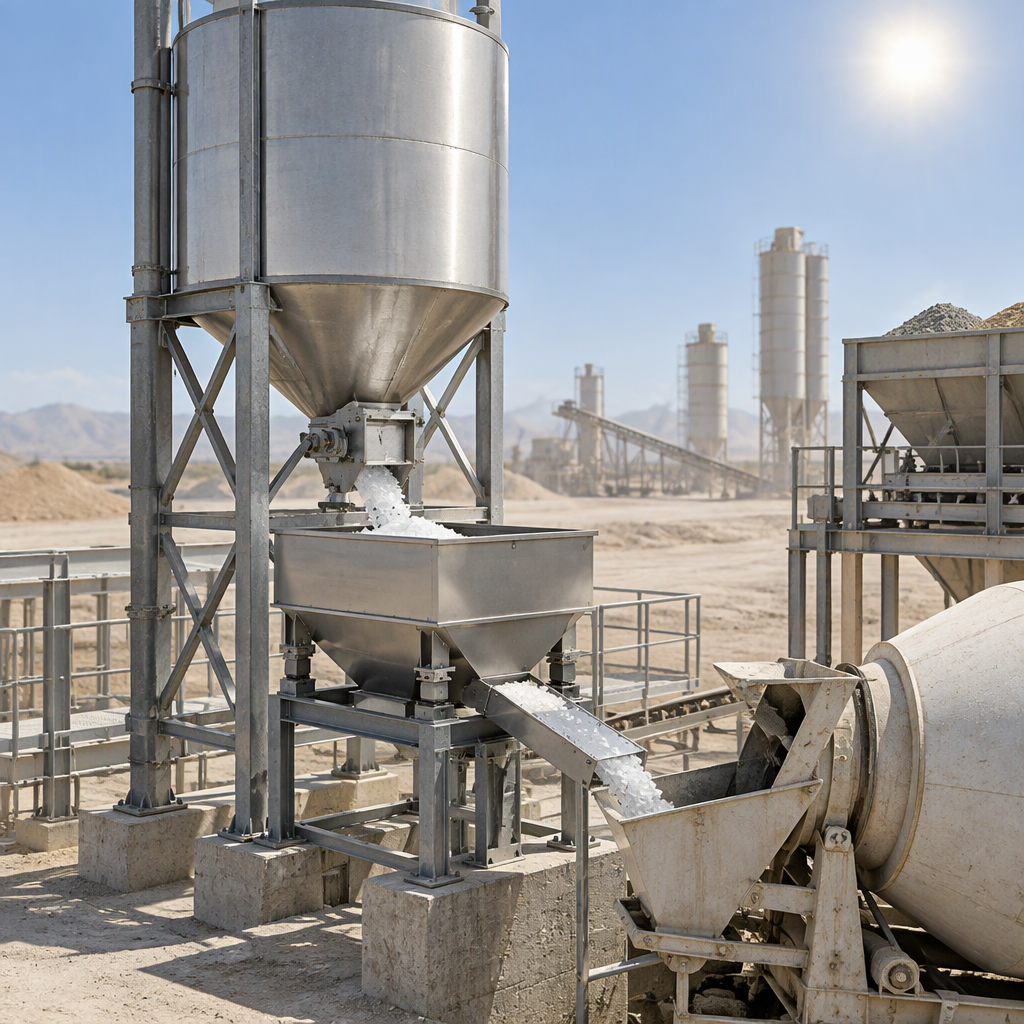
In practice the scope splits into a refrigerated side and a batching side. Shenzhen Brother Ice System Co., Ltd. describes one integrated concrete cooling arrangement that pairs a flake ice machine quoted at 120 t/day, an automatic ice storage system at 90 t and a water chiller at 360 t, and weighing sits inside the automatic storage and delivery scope the company offers with its containerised ice plants. The batching controller, not the ice plant, owns the decision about when ice is requested, how much is released and whether the batch may proceed — and that boundary is where most of the coordination work sits.
- The unit you are buying is the handover, not the ice machine.
- Measurement principle, signal handshake, acceptance tolerance and batch records are one package.
- Melt and residue belong in the batch record, not in the next batch.
Why is ice harder to weigh than aggregate or water?
Ice changes phase at ordinary plant pressure, so a weighed mass of ice is not a fixed quantity in the way a weighed mass of stone is: part of what leaves the scale can arrive at the mixer as water. It also handles differently — suppliers list flake, tube, plate, slurry and block ice as separate machine types — because the forms convey, bridge and melt at different rates.
| Ingredient | How it is usually measured | What makes dosing harder | What to agree before ordering |
|---|---|---|---|
| Crushed aggregate | Belt or hopper scale with moisture correction | Moisture content varies by stockpile | How moisture is sampled and corrected |
| Mixing water | Dedicated meter on the water line | Very little — the meter is a settled device | Meter calibration and who owns it |
| Flake ice | Dedicated weigh hopper or batch scale | Bridging, residence time and melt before the mixer | Weighing point, tolerance and melt accounting |
A weigh hopper reports the mass it received, not the mass that entered the mixer. Agree who records the difference between the two and how often.
Which signals must the ice system and the batching controller exchange?
The interface is a handshake, not a data feed: the controller requests ice, the ice system weighs and reports, the controller permits discharge, and both sides confirm and record the release.
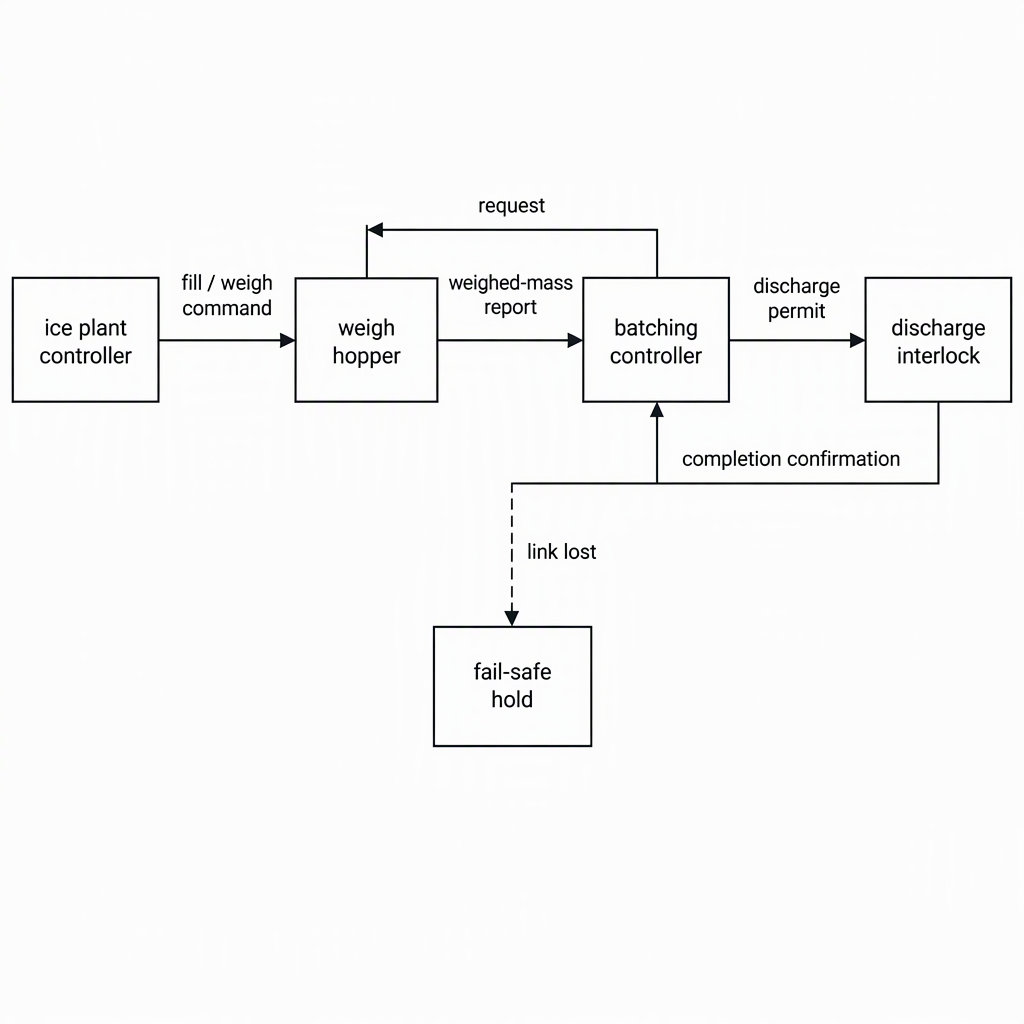
- Request. The batching controller calls for the ice mass its mix design requires.
- Weigh. The ice system fills the weigh hopper to target and holds.
- Report. The measured mass returns to the controller with a valid or invalid status.
- Permit. The controller compares the report with the batch tolerance and permits or refuses discharge.
- Discharge. Ice is released to the mixer only inside the permitted window.
- Confirm and record. Discharge complete and hopper empty are recorded with mass, time and batch ID.
- Direction and owner of every signal, and whether it runs on hard wiring or a network link.
- Behaviour on loss of communication: hold, stop, or finish the current weigh and then stop.
- Whether the controller can abort a batch after ice has been discharged, and what happens to that ice.
- Which alarms appear to the batching operator and which to the ice plant operator.
- Who may change target masses or tolerances after handover.
How should weighing tolerance and acceptance be decided for ice?
Set the tolerance from the batch, not from a catalogue: the smallest mass your mix design will notice, the resolution your controller can act on, and the repeatability your installed line can hold.
| Decision | What to write into the specification | How to accept it |
|---|---|---|
| Measurement principle | Mass measurement in a dedicated weigh hopper; volumetric metering only where you accept the resulting uncertainty | Written description plus on-site demonstration |
| Tolerance and resolution | Permitted deviation per batch, the resolution the controller can act on, and how a deviation is reported | Repeated weigh test at your typical batch mass |
| Acceptance test | Ice form and temperature, number of batches, witness, and what counts as a failure | Signed test record at handover |
| Zero and tare routine | When the hopper is zeroed, the residue allowed, and who checks it | Routine written into the operation and maintenance manual |
| Reject behaviour | What happens to a batch whose ice mass falls outside tolerance | Witnessed fault test during commissioning |
A tolerance demonstrated on a supplier's test rig is not a tolerance for your plant: record your acceptance conditions and repeat the test after any change.
How do you reconcile ice that melts before it reaches the mixer?
Reconcile melt as two records: the mass the ice system weighed and released, and the mass the batching controller accepted into the mixer. Where they diverge, the difference is melt, spillage or residue, and it has to be booked deliberately instead of being absorbed into the next batch.
At ordinary plant pressure, ice changes phase because of temperature, so a mass that leaves the scale as ice can reach the mixer partly as water. NIST publishes evaluated phase-change data for water in its Chemistry WebBook entry for water, which places the ice–water transition at ordinary plant pressures. In the plant the consequence is bookkeeping rather than physics: track the mass released, the mass accepted and the time in transit, and book the difference deliberately instead of absorbing it into the next batch.
- Released ice mass and controller-accepted mass, both time-stamped to the batch ID.
- Ice storage temperature at the time of batching, from the ice plant's own sensors.
- Delivery-path inspection and cleaning interval, recorded rather than assumed.
- A named person who reviews the daily variance and decides whether the mix design or the equipment needs attention.
How much storage buffer and throughput does a dosing line need?
Size storage from your batching cycle rather than from the ice machine's daily output: count the largest ice mass you need between two refills, add the time the ice plant needs to recover, and check that the delivery and weighing path can move that mass inside the mixer's charging window. Suppliers of automated ice storage and delivery for large-scale concrete cooling describe PLC-controlled storage with automated delivery, which is the part that has to keep up with the batch cycle.
- List the peak batching pattern: largest ice mass and shortest interval between batches.
- Convert it into the ice mass per hour the weighing line must deliver.
- Compare that figure with the delivery and weighing rate, not with the ice maker's daily rating.
- Size the insulated buffer for the gap between ice production and batching peaks.
- Confirm recovery time after a peak, and test the whole sequence at peak rate before handover.
Blocked gates and bridged hoppers are one failure mode to design and inspect for on an ice delivery line. Before anyone reaches into a hopper, gate, screw or conveyor to inspect it or to clear a blockage, switch off the drive, isolate and lock off the power supply, and then use only the access the manufacturer's manual permits. Never clear a jammed gate with the drive live.
What should engineering procurement confirm before ordering an ice weighing and dosing system?
Confirm four document sets before the order: the interface signal list, the weighing acceptance test, the responsibility matrix and the handover records. If any of them is still an open discussion, the specification is not ready to buy against.
- Interface document signed by both the ice-system supplier and the batching-control supplier, naming each signal and its owner.
- Weighing principle, target masses, tolerance and reject behaviour written into the technical specification.
- On-site acceptance test defined by ice form, storage temperature, batch mass, repetitions and witness.
- Responsibility matrix covering ice mass accuracy, delivery-path melt, water addition and final concrete temperature.
- Batch-record format agreed with the plant's quality system, including time stamps and batch IDs.
- Calibration and zero-check routine with an interval and a named owner.
- Layout and general-arrangement drawings prepared for your installation — the supplier offers customised solution plans and drawings per order, so ask for your plant rather than a reference project.
- Energy-isolation and lock-off points identified before commissioning, together with the manufacturer's permitted access procedure.
- Training for the batching operator and the ice plant operator, including fail-safe behaviour and alarm handling.
Conclusion
What decides whether the installation works is not the ice machine's rating but who owns the measured mass at the handover point, and who is allowed to act when that mass falls outside tolerance.
Plan ice weighing and dosing as a control interface rather than as a piece of equipment. Fix the measurement point and the acceptance test while the specification is open, and keep melt and residue visible in the batch record.
Frequently asked questions about ice weighing and dosing
Buyers usually ask about the measurement method, the interface with the plant controller, acceptance tolerance and who is accountable when a batch misses its target. The answers below follow the same order as the decisions above.
Does ice need its own weigh hopper, or can it be metered by volume?
Mass matches a mix design directly, so use a dedicated weigh hopper or batch scale; volumetric metering can only pre-feed, because flake ice bridges, compacts and shifts with form and temperature.
How does the ice system talk to the batching control system?
Through an agreed signal list: a call for ice, a weighed-mass report with a validity flag, a discharge permit and a completion confirmation, signed by both suppliers on one interface document.
Our factory makes ice for fish and food; does concrete dosing design apply to us?
Partly. Mass measurement, interlocks, fail-safe behaviour and batch records transfer directly to any ice-handling line. The acceptance tolerance, delivery route and record format do not, because they follow the receiving process. Use concrete dosing as a design pattern and re-qualify the weighing arrangement for your own product and hygiene requirements.
Who is responsible when a batch temperature or ice mass is out of tolerance?
Split it in the contract, not the argument afterwards: the ice supplier owns the weighed mass at its scale, the batching supplier owns how that mass is accepted and recorded, and the producer owns mix design, moisture and placing conditions.
Can automation alone guarantee in-tolerance concrete temperature?
No. Automation can weigh ice and refuse a batch outside its permitted mass, but it cannot see aggregate moisture, cement temperature or placing delays. Keep temperature decisions with a named person.
Does the form of ice change the dosing design?
It changes the hardware, not the principle. Flake, tube, plate, slurry and block ice are offered as separate machine types because they convey, bridge and melt differently. Choose the form for your process first, then size gates, hopper geometry and weighing equipment for it.
How is the weigher calibrated and checked after handover?
Agree it as a routine rather than an annual event: a zero check before production, a repeatable check mass, a documented interval and a named owner. Have the method written into the manual at handover.
Does melt water count as mixing water?
Water that arrives with the ice is water in the mix. Record the mass released and accepted, keep the difference visible in the batch record, and let the mix designer decide on any adjustment.
