


A poultry processing ice system should be specified from the process map outward: identify where ice or chilled handling is needed, when demand peaks, and how each delivery point connects to hygiene controls. For U.S. official poultry establishments, chilling is also a regulated process area addressed by FSIS guidance. If water, ice, or solutions are reused, procurement should define the sanitation boundary before requesting equipment quotations.
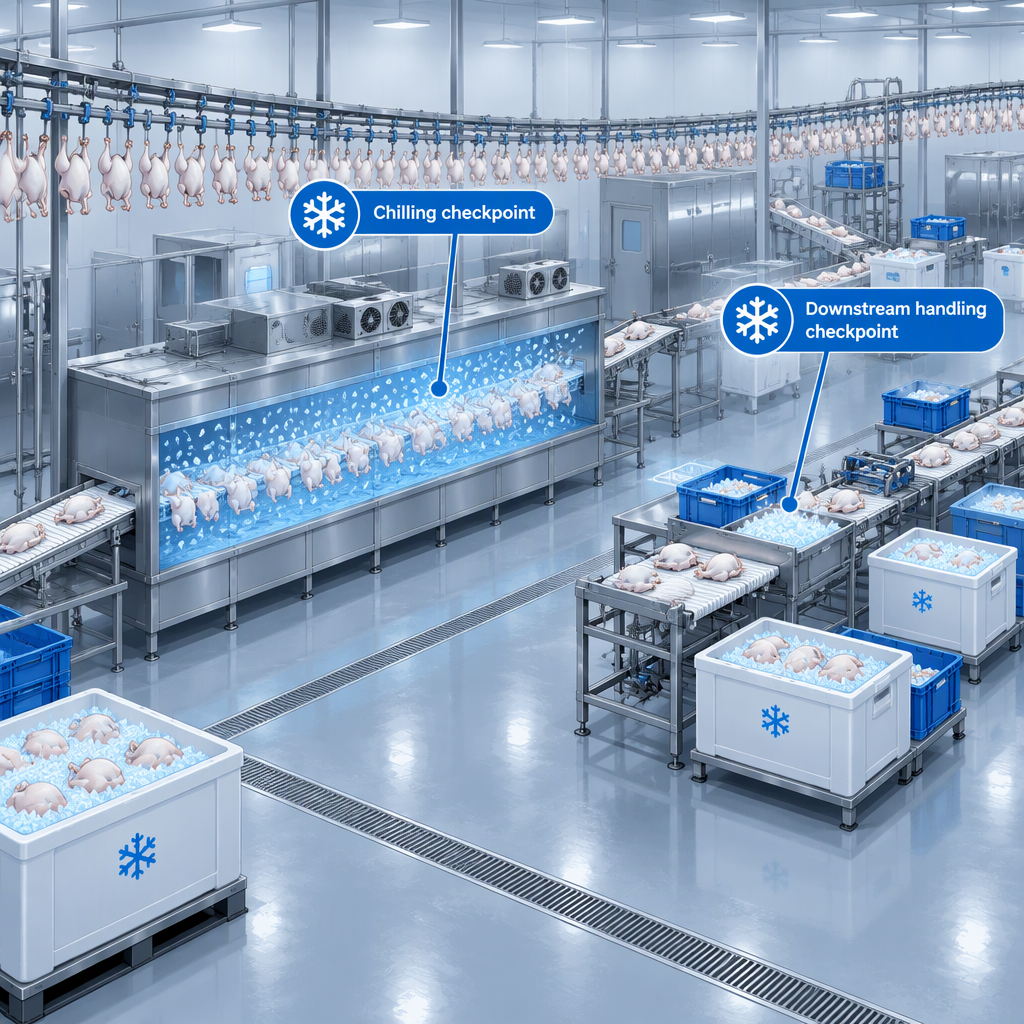
Map the poultry process before estimating ice demand
Start by mapping ice demand to the poultry process stages, because broiler processing includes steps such as scalding, defeathering, evisceration, washing, and chilling, and chilling practices can vary by country and plant method.
- Define the product path. Record the major process stages from live-bird receiving through washing, chilling, packing, and dispatch, then mark where product temperature control or chilled contact is required.
- Separate chilling from other cold-handling needs. Chilling is a specific process stage; downstream holding, packing support, or tote icing may create different timing and delivery requirements.
- Document the local processing method. Because processing practices and regulations vary by country, the same headline application can require different ice-contact, water-contact, or air-chilling assumptions.
- Use the map as the sizing input list. Before asking for a poultry processing ice system quotation, collect line schedule, product mix, target use points, and operating hours for each point rather than relying on one daily tonnage.
Define demand by load, timing, and operating window
Define demand by process load, peak timing, and operating window, not only by daily production, because poultry chilling is a process-critical area and the plant must align ice availability with actual slaughter and handling conditions.
- List each point where ice may be needed: chilling, chilled water support, post-chill handling, packing support, temporary holding, or transport preparation.
- For each point, record the expected operating window: continuous, batch, peak-shift, cleanup-support, or contingency use.
- State whether demand is steady, pulsed, or seasonal, because storage and distribution interfaces change when peak demand is concentrated.
- Collect process inputs that affect supplier calculations: product type, throughput, incoming temperature, target temperature, ambient conditions, storage strategy, and allowed ice contact.
- For plants under U.S. poultry inspection, align chilling assumptions with the current requirements and guidance that apply to the establishment rather than treating supplier literature as the compliance basis.
Account for the chilling method before selecting equipment
Clarify whether the plant uses immersion chilling, air chilling, or another approved local method before selecting equipment, because FAO material identifies immersion chilling and air chilling as common methods and notes that practice varies by country.
| Chilling context | Ice-system question to answer | Procurement implication |
|---|---|---|
| Immersion chilling is one common poultry-chilling method. | Will ice support chilled water temperature, direct contact, storage, or replenishment? | Define water and ice-contact boundaries, replenishment timing, and transfer route to the chiller area. |
| Air chilling is also a common poultry-chilling method. | Is ice needed elsewhere in the process, or is demand mainly downstream of the chiller? | Avoid assuming an immersion-style ice load; map actual cold-handling points and storage needs. |
| Processing practices and rules vary by country. | Which local authority, customer standard, or plant HACCP team controls the acceptable method? | Ask suppliers for equipment interfaces after the plant confirms the applicable process and compliance basis. |
Define delivery points as engineering interfaces
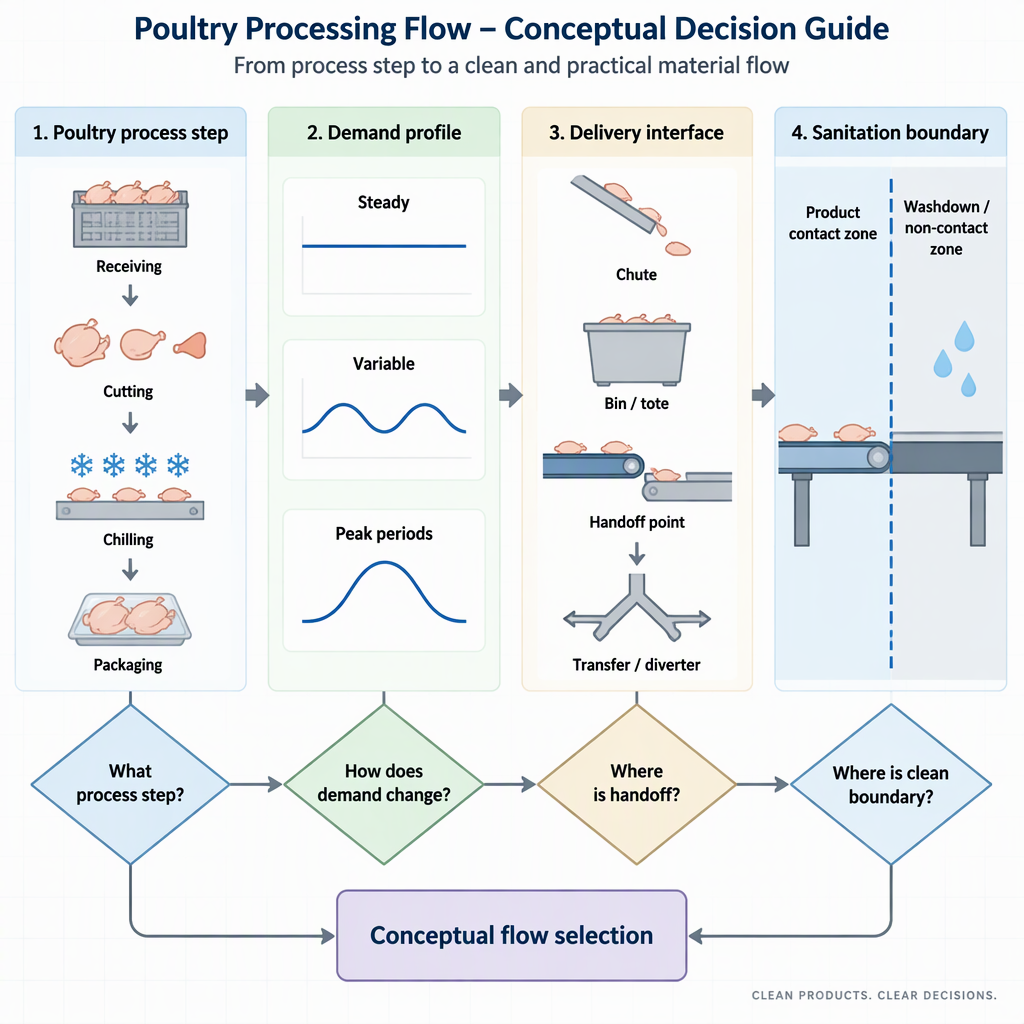
Treat delivery points as engineering interfaces: the process map tells you where ice may be needed, while each interface defines how ice must arrive, be stored, and remain within the plant’s hygiene boundary.
| Delivery point to define | Questions for engineering and procurement | Why it matters |
|---|---|---|
| Chiller or chilling support area | Is ice fed continuously, in batches, manually, or through a controlled transfer route? | Feed timing and contact rules affect storage location, transfer method, and sanitation review. |
| Packing or post-chill handling | Does ice go to totes, bins, packing stations, or intermediate storage? | The interface determines whether the buyer should specify bins, conveyors, screws, pneumatic transfer, or manual handling limits. |
| Water, ice, or solution reuse boundary | Is any ice, water, or solution reused, recirculated, or returned to a process area? | Reuse requires a defined sanitary boundary and plant-approved controls before the equipment RFQ is finalized. |
| Ice storage and distribution route | Where will ice be held, how far will it travel, and what happens during a production peak? | Longer or more complex delivery routes can affect bin arrangement, transfer selection, and the need for peak-buffer storage. |
Set sanitation and jurisdiction boundaries before the RFQ
Before issuing an RFQ, define the sanitation boundary for ice, water, and solution circuits, especially where reuse may occur in meat or poultry establishments.
The FSIS guidance on poultry chilling requirements applies to official establishments producing ready-to-cook poultry and explains chilling requirements related to 9 CFR 381.66(b); the guidance states that it does not itself have the force of law unless authorized by law or incorporated into a contract.
The FSIS guidance on water, ice, and solution reuse addresses sanitation performance standards for official meat and poultry establishments that reuse water, ice, or solutions and relates to 9 CFR 416.2(g).
For food settings, the FDA Food Code is a model used by jurisdictions to develop or update their own rules, and FDA identifies the 2026 Food Code as its most recent full edition on the current page.
Build an RFQ package around verified inputs
A useful RFQ for a poultry processing ice system gives suppliers the process map, demand profile, delivery interfaces, and sanitation boundaries so they can respond to the actual application rather than a vague tonnage request.
- Process description: poultry species or product category, process stages, chilling method, and the points where ice is expected to support the operation.
- Demand inputs: operating days, shift pattern, hourly peaks, expected batch timing, storage buffer expectations, and whether demand is continuous or intermittent.
- Delivery-point schedule: destination areas, transfer distance, bin or station location, elevation changes, manual-handling limits, and required control points.
- Sanitation boundary: whether water, ice, or solutions are reused, where product contact can occur, and what plant procedures govern reuse or separation.
- Regulatory context: the jurisdiction, inspection status, customer standards, and the plant team responsible for confirming chilling and hygiene requirements.
- Commercial scope: whether the RFQ asks for ice making only, storage only, transfer equipment, controls integration, installation support, commissioning support, or spare-parts documentation.
Next step: turn the checklist into a one-page RFQ cover sheet and ask each supplier to respond against the same demand points, delivery interfaces, and sanitation assumptions.
Conclusion
The strongest starting point is not a preferred machine type; it is a clear process map that links poultry-processing stages, chilling method, demand timing, and delivery points.
- Map the process before estimating capacity.
- Confirm the chilling requirements that apply to the establishment and jurisdiction.
- Define water, ice, and solution reuse boundaries before finalizing the equipment scope.
- Send suppliers the same RFQ inputs so proposals can be compared on application fit rather than headline tonnage alone.
FAQs about poultry processing ice systems
These buyer questions help procurement and engineering teams turn a poultry processing ice system inquiry into a clearer application specification.
Where can ice demand appear in a poultry plant?
Ice demand can be evaluated around process stages such as washing, chilling, post-chill handling, packing support, and dispatch preparation, with the strongest focus on the specific stages used by the plant.
Why not ask for one daily ice tonnage?
A single daily number does not show when demand peaks, where ice must be delivered, how much storage is needed, or whether the process requires a sanitary separation between different water and ice circuits.
How do immersion chilling and air chilling affect the discussion?
FAO material identifies both immersion chilling and air chilling as common methods, so buyers should define the actual method before assuming where ice is consumed or how it should be delivered.
What sanitation boundary should be defined before an RFQ?
Define whether water, ice, or solutions are reused, recirculated, or kept separate, and identify the plant controls that apply to those circuits before asking suppliers to propose equipment.
Can one guide state the legal requirement for every plant?
No. Food rules can be jurisdictional, and model codes may be adopted or adapted by local authorities, so buyers should confirm the current adopted requirements and any customer standards with the responsible authority.
What should procurement send to suppliers?
Send a process map, demand timing, delivery-point list, sanitation assumptions, utility constraints, scope boundary, and the plant contact responsible for regulatory or customer-standard confirmation.
What should be clarified if product contact with ice is possible?
Clarify whether contact involves fresh ice, reused ice, chilled water, or solutions, and require the plant’s sanitation and quality teams to define acceptable handling and separation rules.
