


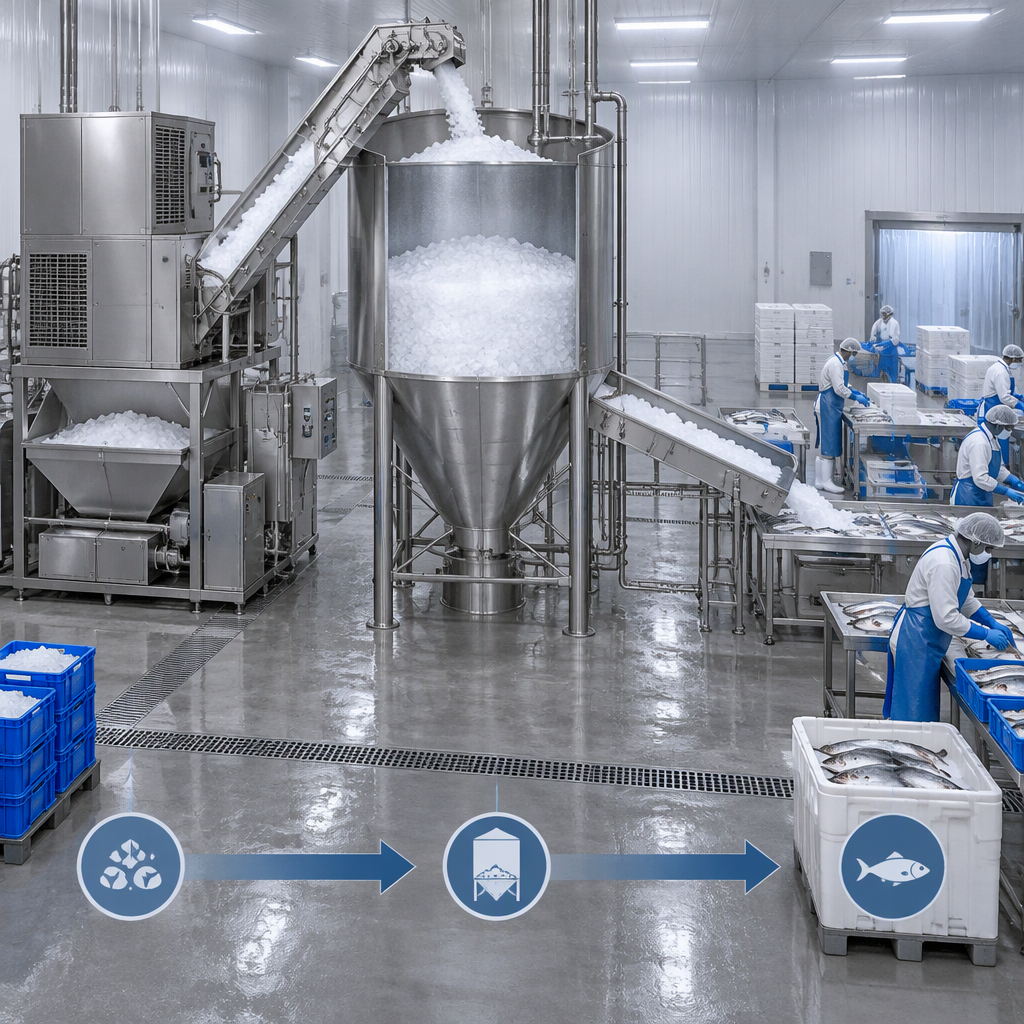
Size storage from demand pattern, not only daily ice-maker output
Start by mapping when ice is made, when it is consumed, and how sharply demand peaks; then use the storage capacity as a buffer between those two curves rather than as a simple nameplate add-on.
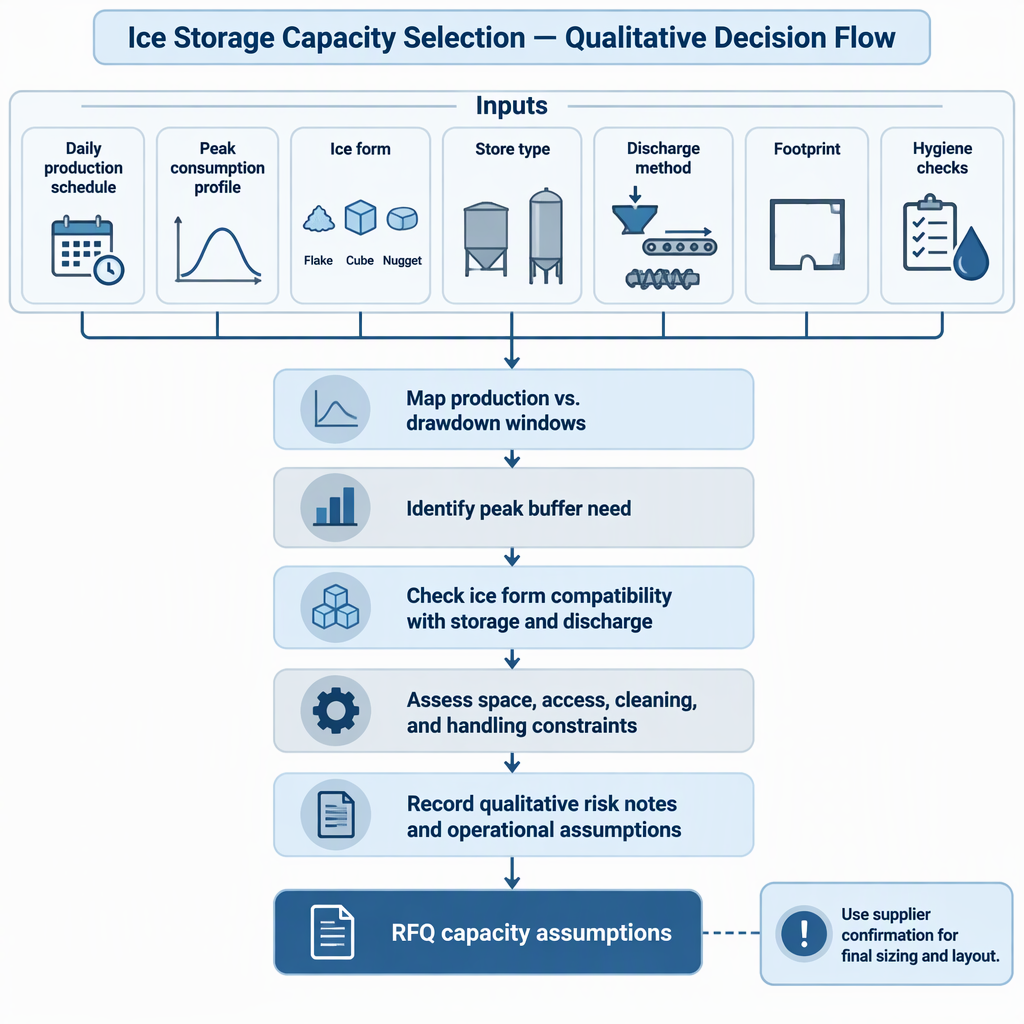
- Define daily ice demand. Record the tonnes of ice needed for normal processing days and for high-throughput days because store size depends on ice demand and demand pattern.
- Separate production from drawdown. A plant that makes ice steadily but consumes it in short batches needs more buffer than a plant with flat, predictable drawdown.
- Choose an initial storage multiple. For fish-handling ice stores, the FAO ice storage guidance describes stores commonly sized at two to four times daily production; treat that as a starting reference to be refined by the actual load profile.
- Check the store geometry. Ice form, store type, required discharge, and available floor area can change the practical volume and footprint for the same mass of ice.
Balance production schedules against consumption peaks
An ice store lets production run on one schedule while processing, landing, packing, or dispatch areas draw ice on another schedule, so the buyer’s task is to size the buffer for the largest credible mismatch.
In seafood applications, FAO links ice-store sizing to ice demand and demand patterns, which makes the demand curve a core sizing input rather than a secondary detail.
The broader energy concept is similar: the U.S. Department of Energy describes thermal energy storage as storing thermal energy for later use and helping balance supply and demand during peak demand periods. For ice storage capacity, use that only as a scheduling analogy; the seafood sizing reference remains the ice-store demand pattern.
For procurement, the most useful schedule is often an hourly or shift-based table showing ice production, ice withdrawal, expected reserve, and the point at which the store reaches its lowest acceptable level.
Account for ice form, stowage density, and handling method
Equal weights of different ice types have practically the same cooling capacity, but the storage volume and handling layout can differ because ice form and stowage density affect how much space the same mass occupies.
| Planning factor | Why it changes the storage decision | Buyer check |
|---|---|---|
| Ice form | FAO explains that cooling capacity is practically the same by equal weight, while volume requirements differ by ice form and stowage density. | Ask suppliers to state usable storage mass and required volume for the specified ice form. |
| Store capacity | FAO provides comparative volume and area requirements for different store capacities and ice forms. | Compare floor area, height, access, and discharge path instead of capacity mass alone. |
| Handling method | Store type and size depend on ice type, demand, and demand pattern, so manual removal, mechanical discharge, and batch drawdown can lead to different practical layouts. | Describe whether ice is drawn continuously, in bins, by conveyors, or in large batches. |
The ice-quality and ice-form caveat can be checked in the FAO page on ice used in fresh fish handling, which distinguishes cooling capacity by weight from volume requirements by form.
Choose the store configuration that fits space and discharge needs
Choose the storage configuration after the demand pattern is known, because the right arrangement depends on capacity, ice form, available space, and how the plant must withdraw ice at peak times.
| Configuration direction | When it may fit | Procurement question |
|---|---|---|
| Silo or vertical store | A vertical arrangement may help when floor area is constrained and mechanical discharge is part of the concept. | What usable capacity remains at the required discharge rate and ice form? |
| Bin or bunker store | A bin-style arrangement may be practical where operators need accessible reserve and the site can allocate floor area. | How will ice be loaded, withdrawn, and kept from bridging or dead zones? |
| Block or batch storage | Batch-oriented storage can suit applications where the ice form and withdrawal rhythm are planned around discrete handling steps. | How much labor, lifting, crushing, or transfer equipment is required before use? |
| Manual reserve storage | A manual reserve may suit smaller or backup duties where demand peaks are limited and access is controlled. | Can the manual method safely meet the peak drawdown without delaying production? |
For engineering procurement, the important comparison is not which configuration is universally best, but which one preserves usable ice mass at the site’s peak withdrawal rate and within its building envelope.
Protect product quality and hygiene while adding storage
For seafood and food applications, capacity planning must include ice quality: FAO states that ice for fish cooling should be made from fresh water or seawater meeting potable microbiological standards and free of objectionable substances.
- Specify the water source and the potable microbiological standard expected for ice used in product contact or fish cooling.
- Confirm that stored ice is protected from objectionable substances during production, storage, transfer, and withdrawal.
- Match access doors, bin openings, discharge equipment, and handling routes to the chosen store type so capacity does not create unnecessary contamination or handling exposure.
- Ask suppliers to distinguish cooling mass, storage volume, and hygiene controls rather than treating all ice forms as identical because their weight-based cooling capacity is similar.
Build the RFQ checklist for an ice storage capacity decision
A useful RFQ should give suppliers the load profile, ice form, operating schedule, hygiene requirements, site constraints, and discharge expectations so they can propose a storage capacity that matches the application.
- Daily ice production target and the expected range between normal and peak demand days.
- Hourly or shift-based consumption peaks, including receiving, processing, packing, and dispatch windows.
- Ice form and required product-contact quality, including potable-water expectations where applicable.
- Preferred store configuration, available footprint, height limits, access constraints, and discharge route.
- Minimum reserve requirement and acceptable recovery time after a peak drawdown.
- Supplier documents requested: capacity basis, layout drawing, discharge method, utility assumptions, hygiene boundary, maintenance access, exclusions, and any certifications claimed for the offered equipment.
Do not use competitor brochures or general market claims as proof of a supplier’s capability. Request current first-party documents for any quoted specification, certification, service scope, delivery time, warranty, or performance claim.
Conclusion
The practical decision rule is to size ice storage around demand pattern first, then refine the capacity by ice form, store configuration, discharge method, footprint, and hygiene boundary.
- Use the two-to-four-times-daily-production reference as an early seafood ice-store planning range, not as a final project calculation.
- Compare storage mass and storage volume separately because ice types can have similar cooling capacity by weight but different space requirements.
- Keep hygiene requirements in the sizing discussion when ice will be used for seafood or food handling.
A sound RFQ turns peak consumption, production schedule, ice form, site layout, and product-quality requirements into a capacity basis that suppliers can price and document consistently.
FAQs about ice storage capacity
These questions help buyers test whether a proposed storage capacity matches the real operating profile rather than only a daily production number.
How many days of ice storage should a seafood plant plan for?
FAO guidance for fish-handling ice stores describes stores commonly sized at two to four times daily production, but the right project value depends on ice type, ice demand, and demand pattern.
Is daily ice-maker output enough to size the store?
No. Daily output is only one input; store type and size should also reflect when ice is consumed and how sharply demand peaks.
Does ice type change required storage volume?
Yes. Equal weights of different ice types have practically the same cooling capacity, but their volume requirements differ because ice form and stowage density differ.
Which storage configuration is best?
There is no universal best configuration. Compare silo, bin, block, or manual reserve concepts against the ice form, demand pattern, discharge method, and available space.
What hygiene issue matters most for food and seafood ice?
Ice used for fish cooling should be made from fresh water or seawater meeting potable microbiological standards and should be free of objectionable substances.
How should peak demand be shown in an RFQ?
Show peak demand by hour or shift, including the expected drawdown rate and the lowest acceptable reserve, because demand pattern is central to storage sizing.
Is ice storage a form of load shifting?
As a scheduling concept, yes: thermal energy storage stores thermal energy for later use and can help balance supply and demand during peak periods. For seafood ice storage capacity, still use direct ice-store sizing inputs for the final design.
