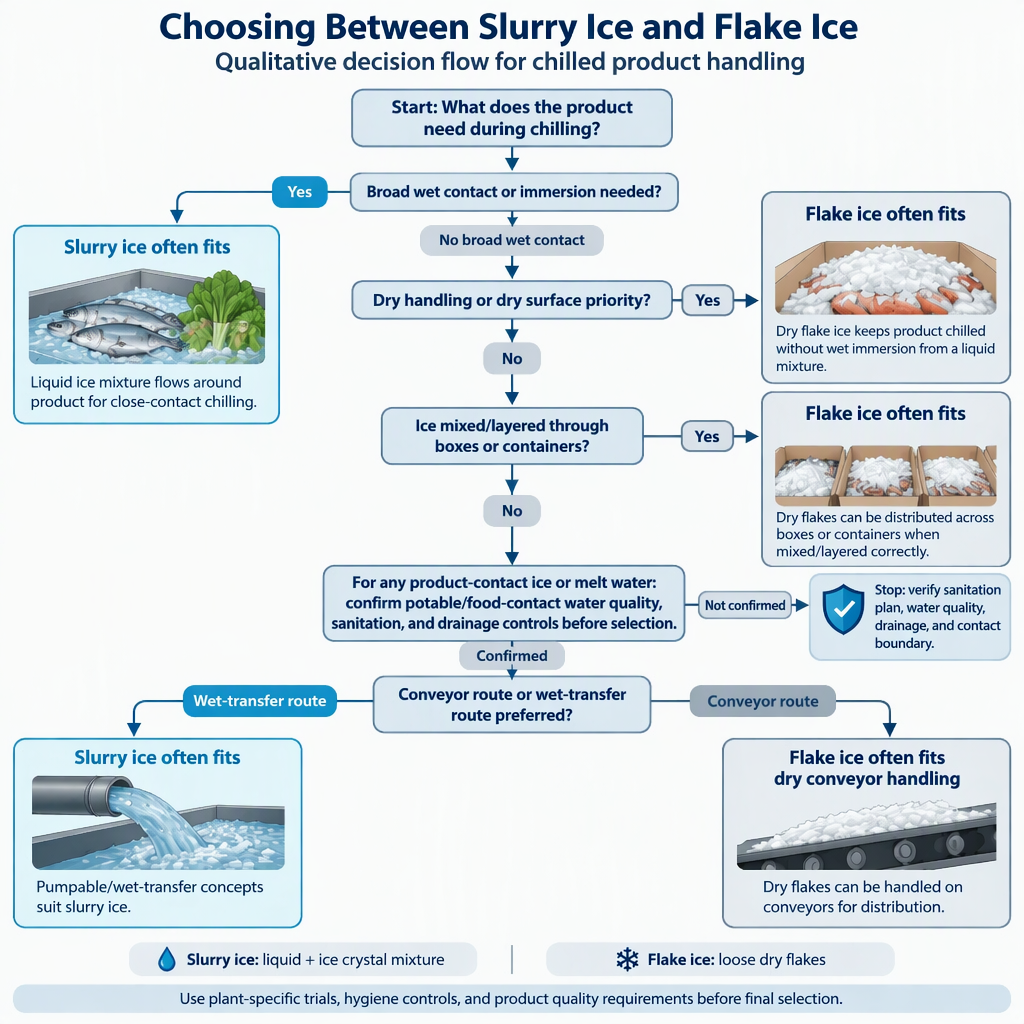
Slurry Ice vs. Flake Ice: Evaluating Product Contact and Handling Needs
For equal weight, ice types have practically the same cooling capacity, so the slurry ice vs flake ice decision should start with contact pattern, distribution, hygiene boundary, and handling route rather than a universal claim that one form has more cooling power.When fast product-surface cooling is the priority, maximize direct ice or cold melt-water contact; when dry handling, box icing, and simpler movement are priorities, evaluate whether flake ice fits the workflow.
Compare the product-contact pattern first
Choose by how much cold surface actually touches the product: fish can be chilled by direct ice contact or by cold melt water, and more contact increases cooling rate.
Flake ice contact
Flake ice offers a large surface area compared with some other solid ice forms, and FAO guidance notes it is dry, easy to handle, and among the least damaging forms of ice discussed for fish handling.
For boxed fish, the contact advantage depends on distribution; if ice must chill the fish, it should be well mixed rather than placed only on top.
Slurry or ice-water contact
A slurry or ice-water approach is most relevant when the process goal is broad wet contact around product surfaces, because immersion in iced water can provide maximum surface heat transfer.
Any water or ice that contacts fish or food must stay within the hygiene boundary, because polluted-water ice can contaminate fish.
Where flake ice fits best
Flake ice fits best when the operation needs a dry, easily handled solid ice that is gentle to fish, provided the plant can distribute it well enough to maintain contact.
Use flake ice for box icing only when the packing method can mix or layer ice so bottom product is not insulated by product above it.
Favor flake ice where low product damage and dry manual handling matter in the receiving, packing, or dispatch workflow.
Check the conveying method before specifying flake ice, because pneumatic systems need careful design and high-velocity impact can reduce flake ice to slush.
Where slurry ice or ice-water contact fits best
A slurry ice or ice-water approach fits best when the priority is wet contact over as much product surface as possible, especially before packing or during a controlled chilling step.
Good fit signals
Consider slurry or ice-water contact when the process benefits from direct cold water contact and rapid heat transfer across exposed product surfaces.
Fit checks before purchase
Confirm how product will be loaded, drained, transferred, and packed afterward, because effective chilling still depends on contact and distribution rather than the name of the ice form.
Cooling capacity is not the same as cooling rate
Equal weights of different ice types have practically the same cooling capacity; the practical difference is how quickly that capacity can be transferred through surface area and contact.
If the plant needs to chill fish to 0°C as quickly as possible, the specification should define the contact method, residence time, drainage, product depth, and packing sequence instead of relying only on ice name.
Set the hygiene boundary before ice touches product
Any ice that touches fish or food should be treated as a product-contact material: the water source and the ice must be suitable for that contact.
Specify that fresh-water or seawater ice used around fish meets potable-water microbiological standards and is free of objectionable substances.
Define how the plant prevents contaminated ice or melt water from touching product.
For wet contact, define how cold melt water or ice water contacts product, drains, and is controlled during handling.
For boxed product, define how ice is distributed so the cooling duty is not left only to top ice.
Match the ice type to the handling route
Procurement should compare the complete handling route—manual movement, conveyor transfer, pneumatic delivery, pumping, box filling, drainage, and cleaning access—because ice form alone does not define handling performance.
Handling route
Buyer check
What this means for your specification
Manual removal or local transfer
Can operators move the ice without damaging product or losing distribution control?
Flake ice may suit dry handling, but product contact still depends on mixing and placement.
Conveyor delivery
Will the conveyor preserve the intended ice form through transfer points?
FAO describes conveyors as an ice-handling method, so the route should be specified as part of the system, not assumed.
Pneumatic delivery
What velocity, bends, and impact points will the system impose?
Pneumatic systems require careful design for ice, especially flake ice, because high-velocity impact can reduce flakes to slush.
Wet transfer or immersion
How will water quality, drainage, residence time, and product recovery be controlled?
Iced-water contact can support high surface heat transfer, but the process must manage contact and removal steps.
Map where ice first touches the product and where it may separate from the product.
Ask suppliers how their proposed transfer method preserves the required ice condition at the point of use.
Selection table for engineering and procurement teams
Use a criteria table rather than a universal winner: flake ice and slurry ice solve different contact and handling problems depending on product, package, route, and hygiene controls.
Criterion
Flake ice tends to fit when
Slurry ice or ice-water contact tends to fit when
Primary cooling mechanism
Dry solid ice contact and large flake surface area are useful for packed or handled product.
Wet contact or immersion is useful when maximum surface heat transfer is needed.
Boxed product
The packing method can distribute ice through the box, not only on the top.
A pre-chill or wet-contact step is needed before final packing.
Product damage concern
A gentle solid ice form is desired for fish handling.
The process can control wet contact without excessive mechanical handling.
Handling route
Manual, conveyor, or carefully designed delivery routes suit the ice condition at discharge.
The plant can manage liquid flow, drainage, recovery, and sanitation.
Hygiene boundary
Ice and melt water meet product-contact water expectations.
The water phase is controlled as a direct product-contact medium.
If the process requirement is...
Prioritize this question
Fast surface cooling before packing
Which method gives the product the most controlled ice or cold-water contact?
Cooling inside boxes
How will ice be mixed or layered so bottom product is not insulated?
Long transfer distance
Will the conveying route preserve the intended ice form at the point of use?
Direct product contact
What water-quality and contamination controls apply to ice and melt water?
Vendor questions to include in the RFQ
A strong RFQ should ask suppliers to prove how the proposed ice form reaches, contacts, and stays distributed around the product in the buyer’s actual workflow.
Ask how the system supports direct ice, melt-water, or ice-water contact at the step where rapid chilling is required.
Ask what water-quality documentation applies to ice and any liquid phase that can contact product.
Ask how the supplier prevents top-only icing from leaving lower product insufficiently chilled in boxes.
Ask how conveyors, pneumatic routes, or other transfer methods protect the intended ice condition.
Ask whether the proposed flake ice application has controls for bridging, distribution, and product damage.
Ask for site-specific sizing and process assumptions rather than accepting a universal ice-to-product rule.
Conclusion
The most reliable slurry ice vs flake ice decision is not a generic winner selection.Start with the needed contact pattern and cooling rate, then check distribution, hygiene, and the handling route.When ice or water touches product, treat water quality and contamination control as part of the equipment specification.
FAQs about slurry ice vs flake ice
Most buyer questions can be answered by separating cooling capacity from contact, distribution, hygiene, and handling route.
Is slurry ice always better than flake ice?
No. A wet ice-water approach is relevant when broad surface contact is the priority, but flake ice may fit better when the operation needs dry handling, box icing, and a gentle solid ice form.
Does flake ice have more cooling power?
Not by weight. FAO guidance states that equal weights of different ice types have practically the same cooling capacity; surface area and contact affect cooling rate.
Why does ice distribution matter in boxes?
If ice must chill the fish, it should be well mixed with the fish; top-only icing can leave lower fish insulated by fish above them.
Is flake ice easy to handle?
Flake ice is described as dry and easy to handle, but the transfer system still matters because the ice must arrive in a condition that supports the intended product contact.
Can pneumatic systems move flake ice?
They can be considered, but they require careful design for ice; high-velocity impact can reduce flake ice to slush.
What hygiene checks come first?
Check that ice made from fresh water or seawater meets potable-water microbiological expectations, is free of objectionable substances, and is protected from contamination before it touches product.
What should procurement ask first?
Ask where the ice contacts the product, how it is distributed through the load, and how the handling route preserves the intended ice condition at the point of use.